
The Mollii Suit
A New Treatment for Spasticity and Other Motor Function Disorders
As an individual with spastic cerebral palsy quadriplegia, dystonic type, a condition which causes chronic pain, I currently have Botox injections into my legs every four mouths to reduce spasticity. While the Botox is successful in helping my pain levels, unfortunately the effect of the injections only last for 12-16 weeks. I have recently been investigating more permanent treatment options. Although most of these options constitute invasive surgeries, I have just had an assessment for a Mollii Suit. A new technology, this suit is for adults and children with spasticity, muscle tone imbalances, ataxias, dystonia and other forms of motor impairment due to cerebral palsy, stroke brain injury, spinal cord injury or other neurological conditions.
How the Suit Works
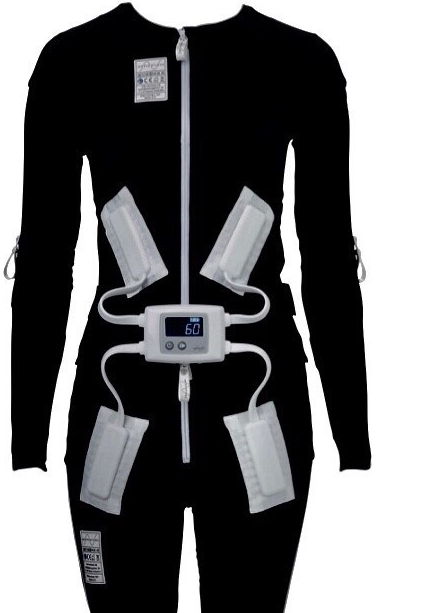
The Mollii suit provides a sensory-level transcutaneous electrostimulation (TENS) to all ‘selected’ muscle groups across the body via the 58 electrodes built in to the soft jacket and trousers. Following an assessment, a small control unit is programmed by the clinical specialist and the suit is worn for a one-hour session to observe the initial effects. The stimulation is understood to induce reciprocal inhibition by stimulating the antagonist muscles to the spastic muscles as well as giving sensory input to help the motor function output. The modulating effects on the nervous system are thought to occur through the activation of sensory afferent pathways which enter and are processed in the spinal cord and higher central neural circuitry. The Mollii Suit is a therapy suit that it is only ever used for an hour a day.
My Experience
My assessment for the Mollii Suit was conducted by two specialised physiotherapists and Richard Welch, Director of UK distribution of the Mollii suit. Measuring all of my range of movements, the initial physiotherapy assessment was thorough. Identifying the muscles which would benefit from a reduction in spastic tone, the physiotherapists programmed the control unit of the Mollii Suit to target these. Richard walked me through the way the Mollii suit works and the theory behind stimulating the underactive muscles to counteract the tone in the opposite muscle. Before I put the suit on, I was videoed. This process was repeated after I had had the suit on for an hour, allowing direct comparisons to be made. It was thus clear to see how and if the Mollii Suit had reduced my tone or changed my walking pattern.
A word of warning to those contemplating this assessment, steer away from the briefs or cycling shorts you would usually wear to physiotherapy as the 58 electrodes in the suit need to have direct contact with the skin, so wear some nice but tight-fitting underwear. The suit itself consists of two pieces, trousers and a top which have to be very close fitting. Indeed, three people had to help me on with the garment which is actually quite comfortable. After the suit is on and the electrodes are in the right places, the control unit, programmed by the physiotherapists, is attached to the suit and your hour of treatment begins. The electrical stimulation is not painful but can produce a slight tingling or stinging sensation occasionally. Whilst the suit is activated you do not need to do any physio, you can just sit. This is not to say that the Mollii suit requires no effort on the part of the patient, the real work begins after your hour of electrical stimulation is up. In reducing my tone, the suit left me reliant upon my weaker muscles. The hope is by regularly wearing the suit I will be able strengthen my weaker muscles through frequent physiotherapy sessions so that these muscles are no longer completely dominated by their high-toned counterparts.
When the electrical stimulation started, my body began to feel very heavy, every movement felt as I imagine it would after having run a marathon. During the hour in which I was in the suit I had time to contemplate what I looked like in this skin tight black and white garment, which had a timer for a belt counting down the minutes I had left of treatment. While it is not the height of fashion, the suit could easily double as a Halloween costume. You could easily resemble a skeleton or you could always cut holes for your arms and legs out of a cardboard box with an extra hole where the timer is and masquerade as an oven. If you wanted to transform into something a little more sinister you could always go as a bomb with your own inbuilt detonation count down.
After the hour had elapsed, videos were taken and I had another physio assessment, my tone seemed to have all but gone. I was left with jelly legs but the suit allowed me to get into positions that I never had before. I was able to lift my legs a little higher when I walked and my arms did not rise involuntarily every time I tried to do something which required any amount of effort. The Mollii suit had defiantly had an effect.
Anyone contemplating an assessment should note that the Mollii suit is meant to be used regularly. For me the effects of the suit lasted two days. During these two days my tone was reduced but I was also very weak. If I was to trial the suit using it regularly for a period of time this weakness could be improved through frequent physiotherapy sessions. When my tone came back, it did so with a vengeance accompanied by a large amount of pain, both things I had had a brief reprieve from because of the assessment. This is in no way meant to dissuade anyone from trialling the suit. It is an amazing piece of new technology that could really help some people.
How to get the Mollii Suit?
The Mollii suit has the potential to be the treatment I have been looking for but would need to be paired with a substantial amount of physiotherapy at least initially. It is non-invasive and you can easily adjust the amount of stimulation and treatment you need as your condition changes. Yet how do you get it? As a very new technology the Mollii suit is not available on the NHS. Professionals in the NHS have said that while indeed it might work, there is not enough research done on the suit for it to be funded. Instead one doctor recently told me to have an alternative invasive surgery because it would be free! This was very frustrating considering that this surgery would cost the NHS so much more than a month trial of the Mollii Suit.
The Mollii Suit costs £4,100 to buy. However, it is advised that you first rent it for at least one or two months to ensure that the suit works for you. It costs £470 per month to rent a Mollii Suit along with a £2,500. These costs are fairly substantial but if paying for private physio like myself as the NHS does not have any neurological physiotherapists in my area, the expense soon becomes untenable. However, I am looking into possible ways I may be able to get some of my treatment funded. If you are interested in trying the Mollii suit, I had my assessment at Hobbs Rehabilitation, a private centre where I am currently having physiotherapy. The assessment cost £105 and took four hours.
More information about the Mollii Suit can be found via the links below:
http://www.remotion.co.uk/research
http://inerventions.se/en/research/
https://www.hobbsrehabilitation.co.uk/docs/LB_Mollii_MS_Trust_Poster_Sep2016_2.pdf
https://www.hobbsrehabilitation.co.uk/docs/Scott_Reed_Mollii_Poster.pdf
Universities are Ill-equipped to Support Physically Disabled Students.
During my university years I was astonished by the lack of support offered to me as a physically disabled student. This article examines the sheer inequality which disabled students are forced to confront during their studies and offers advice to those embarking on their university journey .

University is hailed as the experience of a lifetime and while it often falls short of this ideal, for students with a physical disability these institutions frequently fail to provide the support necessary for them to succeed. I myself have cerebral palsy quadriplegia and have just graduated from a Russell Group University with a first-class honours’ degree. Throughout my degree, I had to constantly fight for reasonable adjustments to be put into place, simple things like accessible rooms, a timetable that would allow me to get from one class to another without being late and a library card for my personal assistant so that she could pick up books when I was unable to get to onto campus. Having collected information from several students with physical disabilities who attend various universities, it is apparent that at an institutional level universities are ill-equipped to support those with additional needs.
One current student divulged that his university were unable to provide notetakers for all of his lectures. Only after complaining multiple times did the university agree that his fellow students could act as his notetakers offering support that the University could not provide. While this solution at least ensures that he has notes from all lectures, a student should not be reliant on his or her peers for support. I too experienced how the bureaucracy of universities prevented students from receiving the support they need. Having been assured that my lectures would be based solely on one campus before I commenced my course, my timetable in every year of my degree was split between various university sites despite my persistent efforts at the start of every semester to remind timetabling of my needs. At one stage, I had to get a taxi twice daily from one campus to another.
Moreover, in my first year I was forced to hire a personal assistant to meet all of my support needs as university staff were prohibited from pushing my lightweight manual wheelchair due to health and safety regulations. While the university were more than willing to provide a notetaker for lectures, these notetakers would meet students at the door of the lecture theatre, a practice which was entirely useless if like me, you needed help carrying your bag and books to the lecture room. On one occasion I was left to get in and out of a lecture theatre on the seventh floor of a building and abandoned without support for five hours causing me to miss my afternoon lectures. The extent of how underprepared universities are as institutions to support physically disabled students was exemplified to me when I was told not to go to my personal academic tutor to discuss my support needs whether that would be notetaking, exam arrangements or medical extensions as I would take up too much of his time. Whilst I was instead sent to the head of faculty who was extremely helpful, surely personal academic tutors should be equipped to help students with disabilities. Such an arrangement further differentiates disabled students from their peers, making them feel ostracised as a mere annoyance to the university.
Universities seem adapt at accommodating those with specific learning difficulties or mental health issues but less prepared for those with complex disabilities. Indeed, the accessible halls I toured when looking around various universities resembled a disabled ghetto, with most of the accessible accommodation situated in a few flats close to each other. While of course there are practical considerations when building accessible accommodation such as wet rooms, this placement of the accessible rooms exemplifies the sheer discrimination that disabled students have to endure. There would be outcry if students were allocated accommodation based on ethnicity or sexual orientation, yet it is deemed acceptable to group all those with physical disabilities. Moreover this segregation is further apparent as often the accessible seats in lecture theatres are at the very front or back, distancing the student from their peers.
Yet while these incessant struggles mar the University experience for students with physical disabilities, all of the students I have talked to agree that their subject faculty and lecturers are or were extremely supportive and accommodative in regards to their needs. It seems that most lecturers take a vested interest in supporting their students. I myself can testify to this as at one stage during my degree as my lecturers tried persistently to change the lecture theatres that they taught in so I would not have to go from one campus to the other. Furthermore, after having had an unexpected surgery, my lecturer agreed that I could submit an essay instead of sitting a three-hour exam. When the university were reluctant to make reasonable adjustments in light of my physical difficulties, I was always confident that my lecturers would help. In my experience it was my lecturers who gave me the support I needed to achieve my degree.
This article is in no way intended to disincentivise physically disabled individuals from applying or aspiring to attend university but rather the opposite. With my parents having had to fight for my right to receive an equal education throughout my mainstream schooling, I hoped that the support I needed would be easily put into place when I started University, as after all it is the pinnacle of higher education. Yet I was entirely ignorant of the struggles I was about to face to secure reasonable adjustments throughout my four years of study. Therefore, I not only wish to raise awareness of problems that future students may encounter but also desire to offer the little advice I can.
1. Be persistent in asserting that your needs are meet whether this is a timetabling consideration or notetaking support.2. Do not be afraid of approaching the head of faculty if your concerns are not being resolved. 3. Utilise your lecturers, they are there to help and if they cannot they will point you in the direction of someone who will be able to. 4. Investigate the protocol for applying for special considerations or an extension in advance so that if you are ever prevented from submitting an assessment because of your medical condition you will know what needs to be done. 5. Make copies of a hospital letter which explains your health issues so that if you ever need to submit evidence to support an application for special considerations you have it to hand. 6. Get to know your campus; where are the disabled parking bays, the accessible routes to lecture theatres and the lifts in each building. 7. Know what you are entitled to in the way of exam arrangements as universities are often used to the standard extra time of 25 percent and one rest break every half an hour. 8. Most importantly, think carefully about the type of support you will need, investigate the support provided by your university. If you are able to navigate your university independently requiring only a notetaker, then the university support may meet all your needs. However, if you require more practical assistance getting to and from lectures then it may be worth looking into hiring a personal assistant. If this is an avenue you wish to explore Askjules are currently the only agency able to collate both your social services support and the support paid for by student finance England to employ a personal assistant to support you both in and outside University.
While all the students I have contacted have had similarly problematic experiences, I hope that some students with physical disabilities have thoroughly enjoyed university. Yet the struggles disabled students encounter at university are reflective of a more systemic problem, namely that disabled children are not given equal opportunities in early education. It is my opinion that not many people with physical disabilities reach higher education and so there has been no need for universities to be equipped to support them. This needs to change.
 Imy Steele